
Craft
The Vessel Sink Is Set on the Wrong Cabinet
The vessel sink is chosen like sculpture and installed like an afterthought. On a standard vanity the rim lands inches above every height the industry actually recommends.
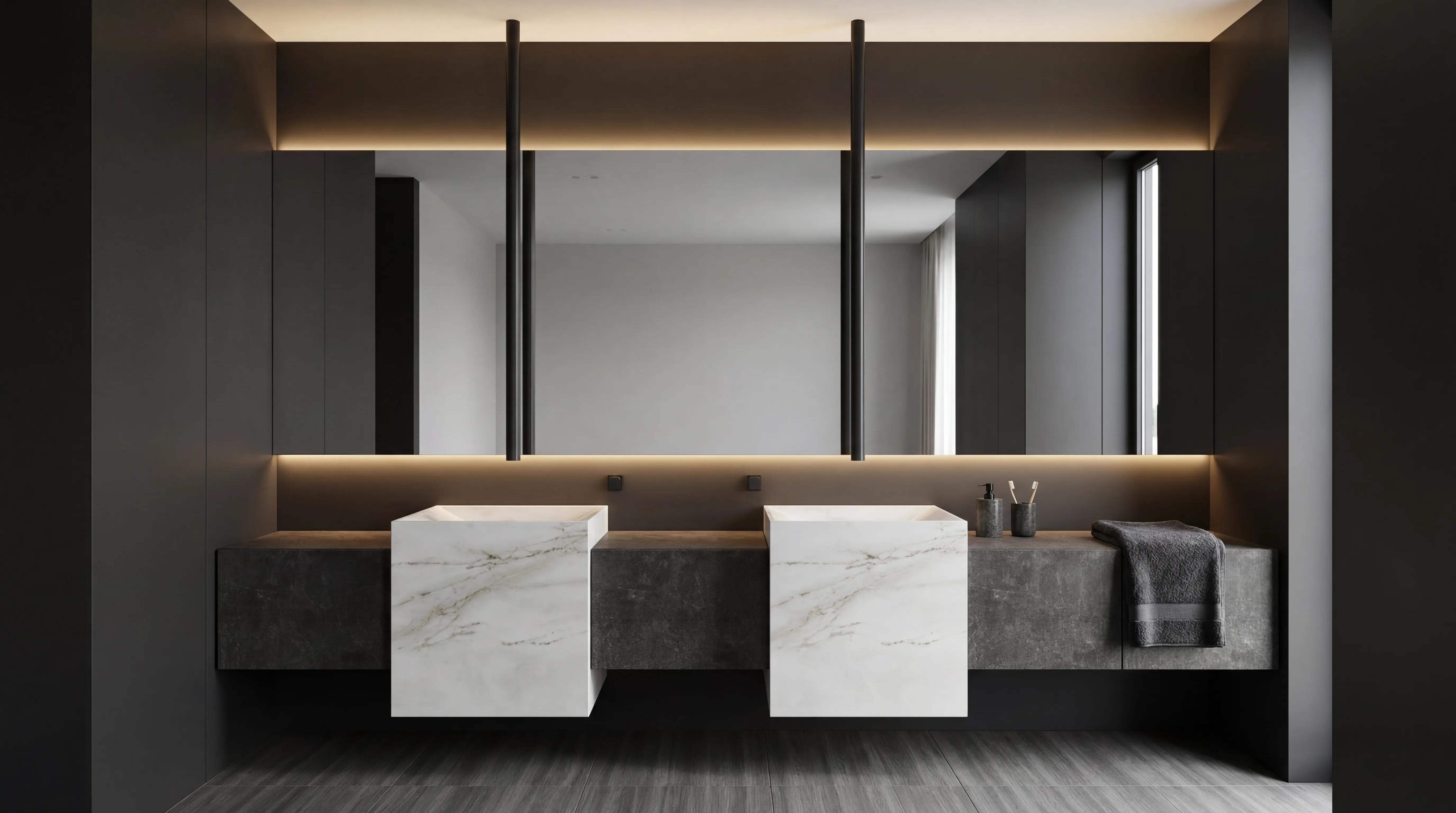
A vessel sink is the one fixture in a bathroom that people choose the way they choose a sculpture — on a plinth, in isolation, under gallery lighting. It is also the only fixture in the house routinely installed at a height nobody calculated.
The bowl is not the problem. A hand-thrown basin or a block of honed limestone can be the best object in the room. The problem is what it gets set on. Vanity cabinets are built for sinks that drop down inside the counter. Put a bowl on top of one and the working surface rises several inches while nothing else moves — not the faucet, not the mirror, not the person using it.
A vessel sink is not a style decision. It is a dimensional one, and most people make it by accident.
The arithmetic in the industry's own manual
The National Kitchen & Bath Association is unambiguous about this in its Bath Planning volume: a vessel basin sits several inches above the counter, so its height must be added to the cabinet and countertop before anyone treats the number as final. The same guidance notes that vanity bases are usually built low — 30 to 32 inches — precisely because the sink was expected to live inside them.
The association's recommended range of adult lavatory heights is 32 to 43 inches, with the rim landing about three inches below the user's elbow. Broken out, that is 32 to 36 inches for women and 37 to 43 inches for men, as published in the NKBA's bath planning guidelines.
Now do the addition. Set a five-inch bowl on a 36-inch comfort-height vanity and the rim arrives at 41 inches — above the entire recommended band for women and near the ceiling of the band reserved for the tallest men. Set the same bowl on a conventional 32-inch base and you land at 37 inches, which is the floor of the men's range and four inches over the top of the women's. There is no standard cabinet that makes a vessel land in the middle of the range for an average adult. That is the whole issue, and it is arithmetic, not taste.
Thirty-four inches is a ceiling, not a suggestion
The federal standard measures this exactly the way you would hope. Under the ADA Standards, a lavatory is measured to the rim or the counter, whichever is higher, and that surface may sit no more than 34 inches above the finished floor. A bowl on top of a cabinet is the higher surface by definition.
Private residences are not bound by that standard, and no one should design a primary bath to a public-restroom rulebook. But the number is not arbitrary. It is where a seated adult can still reach water. Clients who intend to stay in a house for thirty years are quietly designing themselves out of one room at a time, and the vanity is usually the first.
The same standards cap the bottom of a mirror at 40 inches. A vessel pushes the mirror up while the guidance pushes it down. Something has to give, and it is usually the mirror, which is how bathrooms end up with a beautiful basin and a reflection that starts at your collarbone.
What a vessel sink changes besides the height
Three consequences follow the bowl, and none of them appear in the showroom photograph.
The faucet has to grow. A standard spout pours into the rim rather than the bowl, so a vessel demands a tall deck-mounted faucet or a wall-mounted one — a decision that has to be made before the wall is closed, not after the stone arrives.
The splash worsens. Water falls further, and most vessel bowls are shallow with flat bottoms, which is the geometry that throws water back out. The counter around a vessel gets wetter than the counter around an undermount, every day, forever.
And the seam becomes visible. Where the bowl meets the stone there is a bead of silicone, sitting at eye level in the wettest spot on the surface. An undermount hides its joint beneath the counter. A vessel presents it.
Design from the rim down, not the floor up
The fix costs nothing, because it is a sequence rather than a product.
Fix the rim height first. Stand the person who will use the basin at the wall, measure the elbow, subtract three inches. That number is the top of the bowl, and it is the only fixed point in the design.
Then subtract the bowl. Whatever remains is the height of your countertop, and therefore the height of your cabinet. Build to it. A wall-mounted carcass will hang at any height you specify, which is the quiet argument for wall-mounted vanities in general — they answer to the user rather than to a toe kick.
If two people share the room, resist the compromise. The NKBA's own suggestion is two lavatories at two different heights, and it is the correct answer nearly every time. A single height that suits a 5'4" and a 6'2" adult suits neither of them.
And if the arithmetic refuses to work — if the bowl you love would put the rim at 42 inches no matter what — specify it semi-recessed, so the counter carries part of the depth. Or put it in the powder room, where the sink is used for eleven seconds at a time and sculpture is the entire point.
A vessel sink is a good object badly sited more often than it is a bad idea. The bowl was never the mistake. The cabinet under it was chosen for a different sink, and nobody checked.
Book a private showroom tour
If this changed how you are thinking about your vanity, the next step is not another article. It is standing at a basin and finding out where your elbow actually lands. Book a private showroom tour and spend an hour with the BauTeam design team, one on one, at any of our studios — Atlanta, Boston, Burbank, Chicago, Dallas, Las Vegas, Los Angeles, or New York.