
Craft
Range Hood CFM Is Often Just a Guess
Range hood CFM ratings are rarely lab-verified, and the powerful ones trigger a code requirement most kitchen remodels quietly skip before the range arrives.
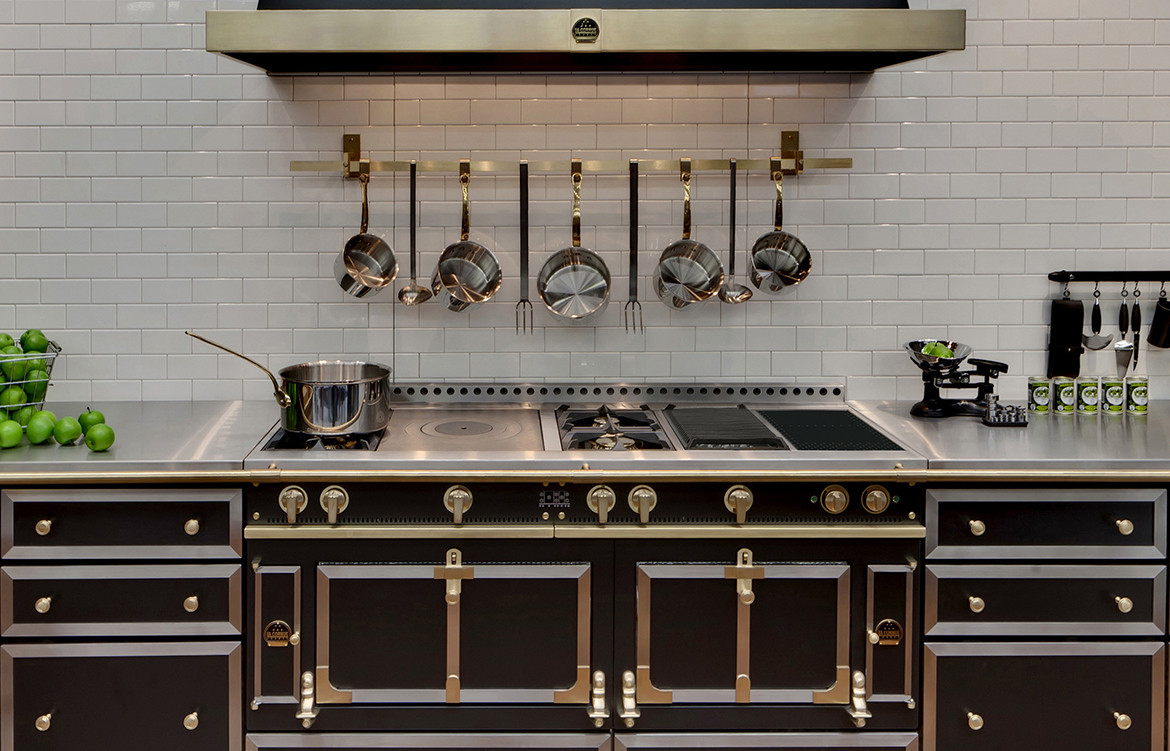
Design guides love to talk about range hoods as a style decision — brass or blackened steel, a sculptural canopy or a quiet insert behind the cabinetry. Almost none of them mention the number that actually determines whether the thing works: range hood CFM, the volume of air it moves per minute. And on a lot of spec sheets, that number was never checked by anyone but the company that printed it.
The Home Ventilating Institute exists for exactly this reason. HVI certification means a range hood's airflow, sound, and power ratings were measured by an independent lab and validated against the manufacturer's claim, not self-reported. A hood without that seal can print any CFM figure it wants. Nobody has to prove it.
So the honest first question about a range hood isn't whether it matches the cabinetry. It's whether the number on the box can be trusted, and whether you actually want it to be as high as it sounds.
Why Range Hood CFM Isn't Regulated
Range hood CFM is one of the least policed specs in a kitchen renovation. Unlike a refrigerator's energy rating or a water heater's efficiency label, there's no federal mandate that a range hood's airflow claim be lab-tested before it ships. HVI's certification program is voluntary. A hood carrying the HVI-Certified mark has had its airflow, sound level, and power draw verified by an accredited lab. One without it is telling you what the manufacturer measured, on equipment the manufacturer chose, under conditions the manufacturer picked.
That matters more at the high end, not less. A boutique manufacturer selling a handful of sculptural hoods a year rarely has the volume to justify the cost of HVI testing, while a mass-market hood from a major appliance brand almost certainly carries it. Price and finish are not proxies for verified performance — if anything, the correlation runs the other way.
Bigger Isn't Automatically Better
Even a verified CFM number can become a liability past a certain point. Under the 2018 International Residential Code, a kitchen exhaust system rated above 400 CFM triggers a makeup air requirement: a mechanism that lets replacement air into the house at roughly the rate the hood removes it. Skip it, and a powerful hood can depressurize the house enough to pull combustion gases back down the flue of a furnace or water heater — a phenomenon known as backdrafting, and a genuine carbon monoxide risk, not a theoretical one.
Kitchen designers routinely spec hoods well above that threshold for open, double-island layouts without flagging that the number they chose crosses a line the local code actually cares about. The fix isn't exotic — a motorized damper tied to the hood, or a properly sized passive vent — but it has to be planned into the kitchen at the framing stage, not bolted on after the range arrives.
Undersizing Is the More Common Mistake
ASHRAE 62.2, the ventilation standard most residential energy codes reference, sets 100 CFM as the baseline local exhaust rate for a kitchen. That's a floor, not a target, and it doesn't scale with a 36-inch gas range or a wok burner. Correct kitchen ventilation needs enough airflow, and correct placement, to actually capture what leaves the pan — steam, grease, and on a gas range, combustion byproducts. A hood that's generous in scale but underpowered in blower and duct will pull some of that upward and let the rest drift into the room, the cabinetry, and eventually the paint.
What to Ask Before You Choose a Hood
Range hood sizing comes down to two questions, asked in this order. First: is this unit HVI-Certified, and can the retailer produce the certification number, not just the CFM figure on the label. Second: if the rated airflow is above 400 CFM, has the mechanical plan accounted for makeup air, and where is it going. A kitchen designer who can't answer the second question in the same conversation as cabinet finishes hasn't finished designing the kitchen.
Get those two answers before you fall for a finish. Everything else about a hood is aesthetics, and aesthetics are the easy part.
A range hood is not a finish choice bolted on at the end of a kitchen design. It's mechanical equipment with a code threshold, a certification standard, and a real job to do — and treating it like jewelry is how good-looking kitchens end up smelling like last night's dinner.
Book a Private Showroom Tour
If this changed how you're thinking about your kitchen's ventilation, the next step isn't another article. Book a private showroom tour and spend an hour with our design team, one on one — no templates, just your space, considered properly. Our showrooms span Atlanta, Boston, Burbank, Chicago, Dallas, Las Vegas, Los Angeles, and New York.