
Craft
Outdoor Kitchen Drainage Is the Only Waterproofing
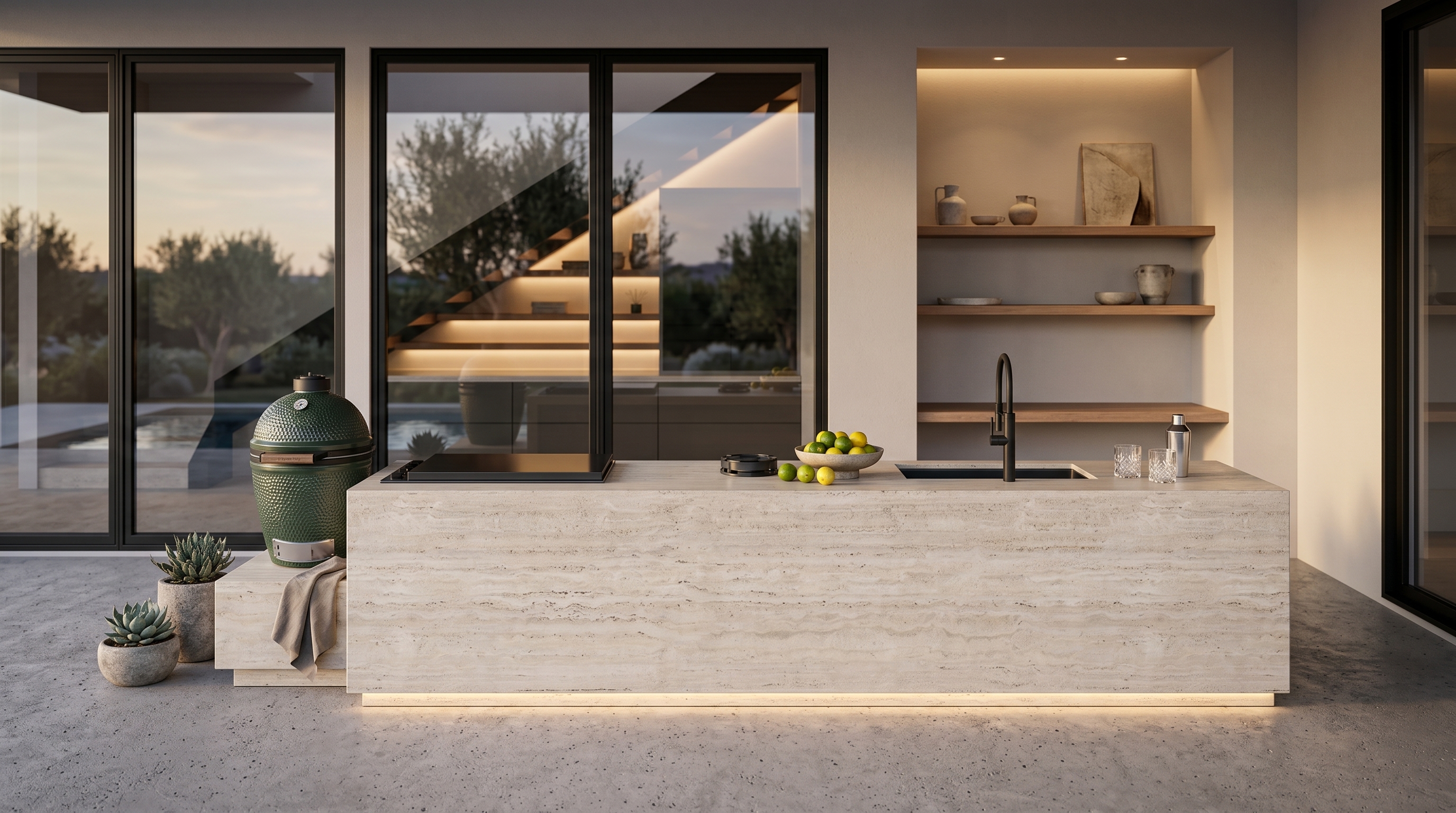
Sealing an outdoor kitchen traps the water it was built to repel. Outdoor kitchen drainage is the only waterproofing that survives a hard winter.
Every outdoor kitchen is sold with some version of the same promise: it is sealed against the weather. Marine-grade this, weatherproof that, a bead of silicone at every joint and a coat of impregnator on the stone. The logic is intuitive. Water is the enemy, so keep it out.
It is also backwards. Outdoor kitchen drainage, not sealing, is what separates a build that looks the same in ten years from one that starts weeping rust and shedding grout in its second winter. Water is going to get in. It arrives as rain, as condensation on the back of a cold appliance, as the runoff from someone hosing down a counter. The only variable you actually control is how quickly it leaves.
Seal a structure that has no way to drain and you have not kept water out. You have kept it in.
Waterproofing accelerates the decay it was sold to prevent
This is not a contrarian opinion so much as a well-documented one. The National Park Service, which maintains more masonry than any luxury builder will touch in a career, is blunt about what happens when you coat a wall with a non-permeable waterproofer: it "will accelerate the decay by trapping moisture behind the new coating." Moisture that cannot evaporate sits in the pores. In cold weather it freezes, expands, and breaks the material from the inside.
An outdoor kitchen is a small masonry building with appliances in it. The same physics apply, compressed into a structure that also gets grease, salt, and a hot firebox on one end. A film-forming sealer on a porous countertop, silicone run around the entire base of a cabinet run, grout lines packed solid at the slab — each of those is a decision to hold water in a place that has no way to dry.
Outdoor kitchen drainage starts at the slab, not the counter
The most consequential drainage decision on the whole project is made before anyone selects a door finish. It is the pitch of the ground the kitchen sits on, and the residential code already has a number for it. The International Residential Code requires grade to fall at least six inches within the first ten feet away from the foundation, and impervious surfaces within ten feet of the building to slope away at no less than two percent.
Two percent is roughly a quarter inch per foot. It is not a lot, and it is invisible underfoot. It is also the difference between a patio that dries in an hour and one that holds a film of water against the toe kick of your cabinetry every time it rains. Most outdoor kitchens that fail early are not built from bad materials. They are built on flat ground, or on ground that pitches gently back toward the house.
Freeze-thaw resistance is a number, not a marketing word
The other half of drainage is material porosity, and here the industry has already done the work of making it measurable. Under ANSI A137.1, the standard specification for ceramic tile, porcelain is defined by a water absorption rate of 0.5 percent or less, measured by the ASTM C373 test. There is a separate standard, ASTM C1026, that exists solely to measure how a tile holds up under freeze-thaw cycling.
Which means the question to ask about an outdoor surface is not whether it is sealed. It is what it absorbs. A material at or under half a percent has almost nowhere to put water in the first place, and needs no chemical film to survive a February. A material at three or four percent will drink, and no impregnator applied once at installation will still be doing its job by the third season.
Specify for evaporation, not for exclusion
The practical shift is small and it happens on the drawings, not on the job site.
Confirm the slab pitch before the cabinetry is ordered, not after. Two percent away from the house, verified with a level, is cheap at the excavation stage and close to impossible to correct once a stone counter is set.
Ask for the absorption figure on every exterior surface — counter, cladding, and floor — and treat anything above one percent as a maintenance liability rather than a finish. Ask whether it has been tested for freeze-thaw cycling.
Leave the base of the cabinetry open. A continuous bead of sealant where the cabinet meets the slab reads as a tidy detail and functions as a dam. Cabinet runs need a way for water that gets behind them to get back out, and air moving through the void is what dries the cavity between rains.
Where a treatment is genuinely needed, choose a breathable, penetrating one over a film that sits on the surface. The goal is a structure that sheds and dries, not one that is wrapped.
An outdoor kitchen built this way will still get soaked. That is the point. It will simply be dry again by the time you use it.
See it built this way
If this changed how you are thinking about your build, the next step is not another article. Our outdoor kitchen systems are engineered to drain and dry rather than to be sealed shut, and the details are easier to understand standing in front of them than reading about them. Book a private showroom tour at our studios in Dallas, Chicago, New York, Los Angeles, Atlanta, Boston, Burbank, or Las Vegas, and spend an hour with our design team, one on one.