
Craft
Outdoor Kitchen Lighting Is Not Mood Lighting
Outdoor kitchen lighting is sold as atmosphere. String lights and a warm glow leave the one surface that actually matters — the cutting board — in the dark.
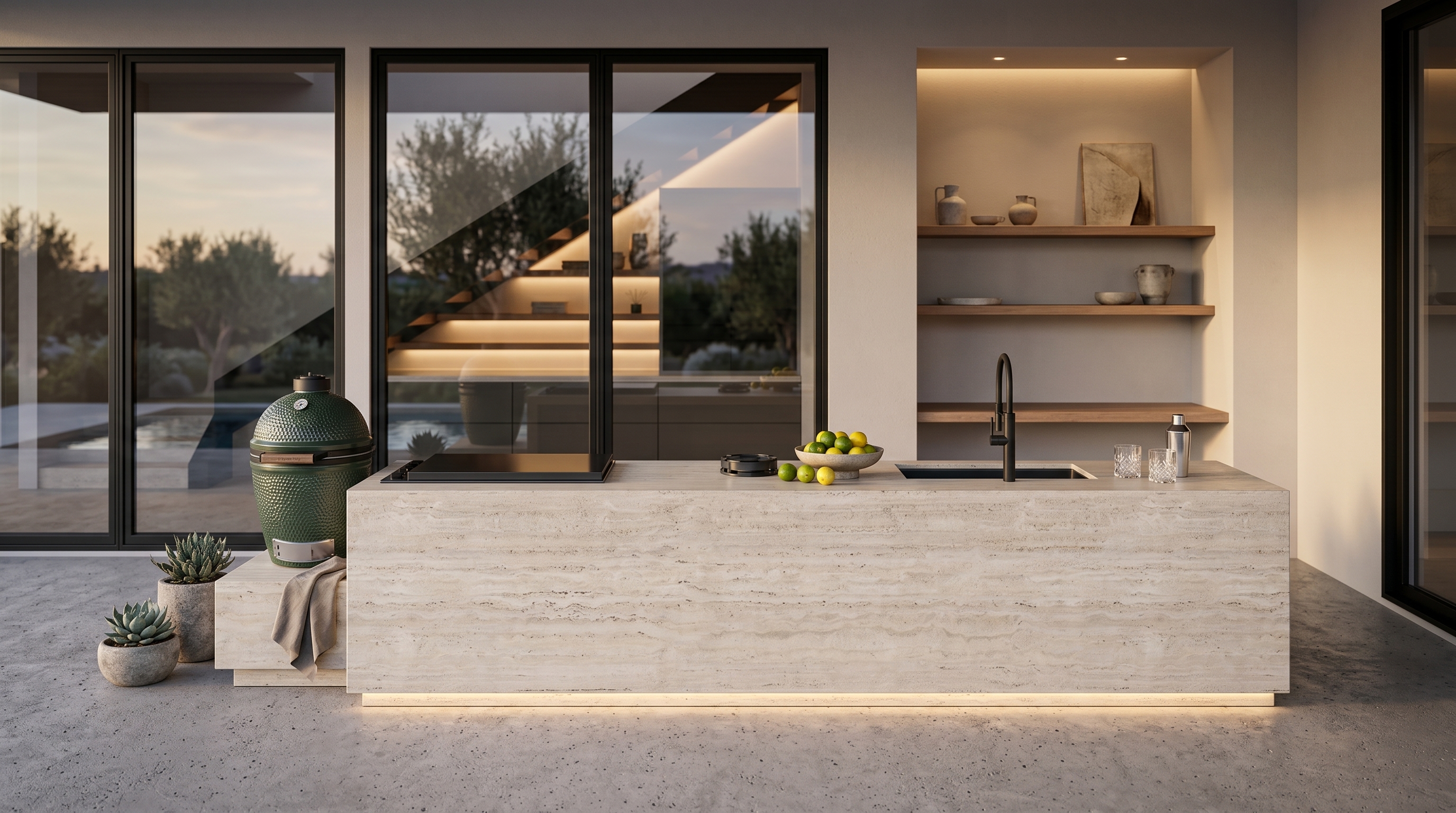
Walk through any well-photographed outdoor kitchen at nine at night and you will find the same scheme: a run of string lights overhead, a warm wash on the stone, a candle somewhere. It looks expensive. It is also why the person at the grill is holding a phone flashlight in their teeth.
Outdoor kitchen lighting is sold as atmosphere. It is really two jobs pretending to be one. The perimeter of the space wants to be dim, warm and quiet. The eighteen inches in front of the cook wants to be bright enough that it would look faintly clinical in a photograph. Design the first, skip the second, and you have built a beautiful room nobody can work in after sunset.
The fix is not more light. It is two systems, on two switches.
The number your outdoor kitchen lighting has to beat
There is a published figure for how much light a person needs in order to safely use a knife, and it is not a matter of taste. The FDA Food Code — the model regulation most states adopt for commercial kitchens — calls for 50 foot-candles, roughly 540 lux, at any surface where someone is working with food or handling knives, slicers or saws. Storage rooms and self-service counters are allowed a fraction of that. The cutting board is the one place the standard refuses to negotiate.
Nobody is going to inspect your patio. But the figure is a useful benchmark, because ambient light was never built to reach it. String lights and a pair of wall sconces deliver a small share of that at counter height, and they deliver it from behind and above the cook, where their own shoulders block it. The light is in the room. It is not on the work.
Warm and dim is a site rule, not a task rule
DarkSky International and the Illuminating Engineering Society jointly publish five principles for responsible outdoor lighting: light should be useful, targeted, no brighter than necessary, controlled by timers or sensors, and warm in color. Every one of them is right — for the property.
Read as a decorating instruction for the whole yard, though, they produce a grill lit like a hotel corridor. Look closely at the second principle. Targeted means shielding and careful aiming so the beam falls only where it is needed. Targeted light on a path is low. Targeted light on a cooking surface is not. These are principles about precision, not about dimness, and the luxury market has quietly misread them as permission to under-light everything.
The guest who cannot see is usually the host
The strongest argument against the atmospheric outdoor kitchen is not aesthetic. It is physiological. According to a National Research Council review of vision and work published by the National Academies, the retina of a sixty-year-old typically receives one third the light of a twenty-year-old's. The aging pupil opens to as little as a quarter of the diameter of a younger one, and the report notes the effect is most serious in dim light.
The person standing at the grill at your house is rarely the youngest person there. A scheme calibrated to look good in photographs is being used by the one pair of eyes in the yard least equipped for it.
Light the work, dim the room
Split the scheme in two and specify each half for its own job.
- Aim task light from in front of the cook, not behind. Under a hood, under a shelf, or from a shielded downlight set forward of the counter edge. Anything mounted behind the cook lights their back and shadows the board.
- Put task light on its own switch. It runs while you cook and goes off when you sit down. That is the controlled principle doing real work rather than decorating a spec sheet.
- Shield every source in the sightline. A bare bulb at eye level is glare, and glare costs you the dark adaptation you need to see the rest of the garden. String lights are the most common offender.
- Keep the perimeter warm and low. 2700K to 3000K, aimed down, dimmed, and doing nothing but describing the shape of the space.
- Specify high color fidelity at the cooking surface. CRI 90 or better. You are judging the color of meat, not the color of stone.
None of this shows up in the photograph, which is precisely why it gets cut. An outdoor kitchen that is planned as a working room rather than a lit tableau costs no more in fixtures. It costs one extra switch leg and an hour of thinking about where the cook will actually stand.
A candlelit terrace is a lovely thing. It is also a terrible place to break down a fish. Light the counter like a workshop, light everything else like a garden, and stop asking one fixture to do both.
Book a private showroom tour
If this changed how you are thinking about your outdoor kitchen, the next step is not another article. Book a private showroom tour and spend an unhurried hour with our design team, one on one — in Chicago, Dallas, New York, Los Angeles, Atlanta, Boston, Burbank or Las Vegas.