Craft
The Luxury Outdoor Kitchen Is Overbuilt
The fully loaded luxury outdoor kitchen sits unused and weathers fast. The best ones do less — and restraint, not appliances, is what makes them last.
The brief almost writes itself. A luxury outdoor kitchen, the thinking goes, should be a second kitchen — grill and side burners, a pizza oven, a full refrigerator, an ice maker, a sink, perhaps a dishwasher and a kegerator, all wrapped in cabinetry that mirrors the one indoors. More appliances, more value, more entertaining. It is the version drawn in nearly every plan and rendered in nearly every showroom.
It is also the version that spends most of its life under a cover.
The most-used outdoor kitchens are not the most-equipped. They are the most edited. A great outdoor kitchen earns its keep by doing one or two things exceptionally well and refusing to do the rest — and the designers building them now know it.
The second-kitchen fallacy
The market has talked itself into maximalism. Outdoor kitchens are now described in the trade as "permanent extensions of indoor kitchens rather than seasonal amenities," and the category has grown to match the ambition — one industry analysis values the global market at USD 27.23 billion in 2025, on its way to USD 60.2 billion by 2034. The growth is real. So is the temptation to spend it on hardware.
But look at what actually gets used. Cooking fixtures — grills, burners, pizza ovens, smokers — make up the functional core of the category, close to a third of it. The rest is supporting cast, and much of it underperforms in the open air. A built-in dishwasher that runs four times a summer. A full-height refrigerator laboring against ambient heat to chill a few bottles. A second sink no one bothers to plumb hot water to. Each is a line item that photographs beautifully and lives idle.
An outdoor kitchen is judged not by how much it contains, but by how little of it goes unused.
Weather is undefeated
Every component you add outdoors is a component the weather gets to attack. This is not a detail to resolve later; it is the central fact of the room. Even marine-grade stainless — the 316 alloy specified for coastal sites — only slows the inevitable. The molybdenum that earns 316 its marine-grade name retards corrosion; it does not stop it. Stainless steel is not stain proof. It is stain less.
This is why the two forces most likely to shorten an outdoor kitchen's life are, by the industry's own accounting, installation-and-maintenance cost and climate dependency. More appliances mean more seals, more electronics, more failure points left out in sun, salt, and freeze-thaw. The remedy is rarely a better gadget. It is fewer of them, better protected — a powder-coat finish over stainless, for one, adds a sacrificial layer that markedly slows corrosion in salt and freeze-thaw.
What restraint actually buys
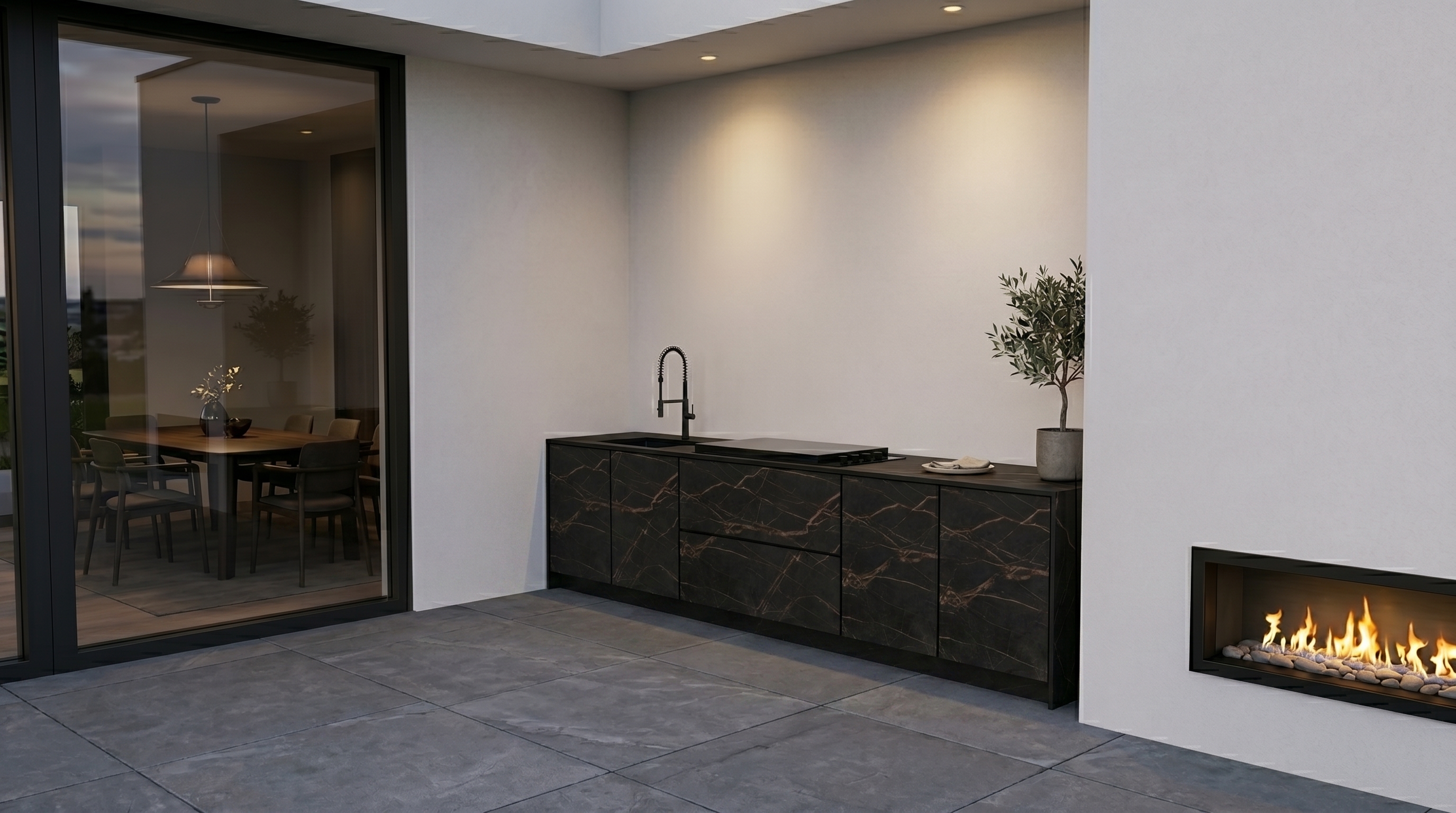
The 2026 design consensus has already turned. The most forward-looking outdoor projects this year are defined by restraint — fewer materials, more continuity, concealed utility, purpose over excess. This is not minimalism as a pose. It is the recognition that an outdoor kitchen lives a harder life than an indoor one and should carry less in order to survive it well.
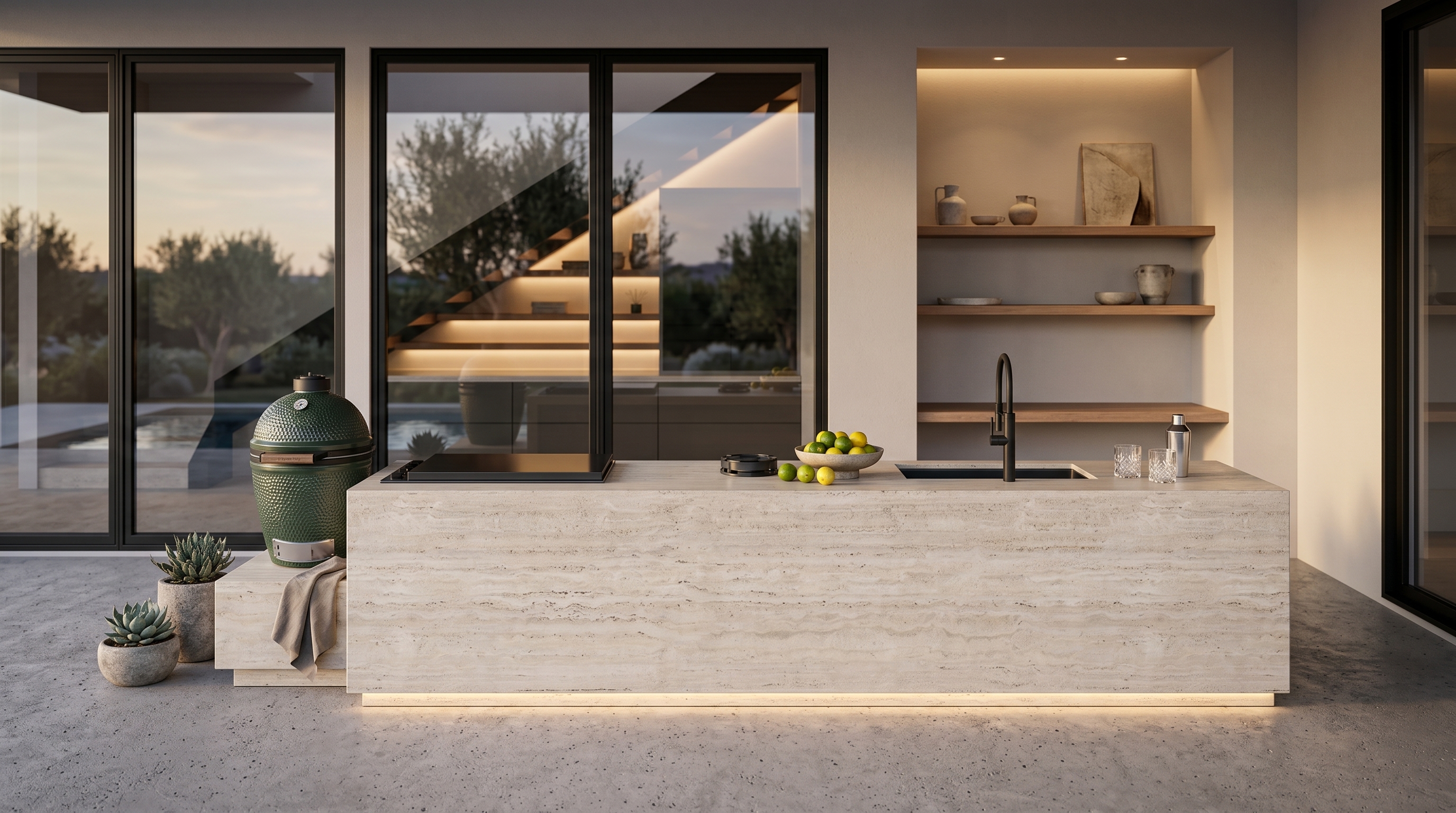
Restraint buys durability, because there is less to fail. It buys budget, redirected from idle appliances toward the things you touch every time you cook — a generous run of counter, real shade, proper ventilation, a clear path between cold, heat, and where people stand. And it buys quiet, the quality that makes a space worth lingering in. A wall of stainless is a showroom. One excellent cooking surface and a stone counter under a pergola is a place.
How to build a luxury outdoor kitchen that lasts
The better brief begins with subtraction. Name the one or two ways you actually cook outside — the grill you reach for weekly, perhaps a wood-fired oven you will genuinely tend — and build the kitchen around them, not around the catalog. Spec for your climate before your taste: near the coast, 316 stainless and a powder-coat finish; everywhere, materials chosen for how they age rather than how they render. Size cold storage to a gathering, not a household — a drawer or two, not a second refrigerator. Then put what you saved into the counter, the shade, and the few feet a cook moves through most.
The result costs less to maintain, ages better, and — the part no one predicts — gets used more, because nothing in it is dead weight.
The outdoor kitchen worth building is not a copy of the one inside. It is the sharper, simpler argument the weather forces you to make: a few things, made to last, in the open air.
See it for yourself.
If this changed how you are thinking about your outdoor space, the next step is not another article. Book a private studio tour and spend an unhurried hour with a BauTeam design consultant — at the studio nearest you in Atlanta, Boston, Los Angeles, or New York. Bring your wish list. We will help you cut it down to what lasts.