
Craft
Counter-Depth Refrigerators Aren't a Compromise
The counter-depth refrigerator is sold as a trade — style for capacity. But the depth you give up is the part that never worked, and food waste proves it.
The counter-depth refrigerator is sold as a sacrifice. You give up cubic feet, the reasoning goes, and you get a cleaner elevation in return — a fair trade for people who care more about how a kitchen looks than how much it holds.
The framing is backwards. The depth you surrender is the part of the refrigerator that was never doing any work. It is the six inches where the leftovers go to be forgotten: the zone your hand reaches into and your eye never does.
A refrigerator does not preserve food. It slows the clock on food you can still see. Everything behind that is cold storage for things you will eventually throw away.
The box grew. The household did not.
According to the Association of Home Appliance Manufacturers, the average American refrigerator held 19.6 cubic feet in 1980. By 2021 it held 25.8 — growth of more than thirty percent. Models above 30 cubic feet are now ordinary in the luxury market, and the 48-inch French-door built-in has become the default gesture of a serious kitchen.
American households did not grow thirty percent in the same period. What grew was the appetite for capacity as a proxy for competence.
The overflow tells the story. The U.S. Energy Information Administration found that in 2020, 34 percent of American homes had two or more refrigerators, with the second one costing about $66 a year to run. A second refrigerator is not a storage solution. It is evidence that the first one is being used as a warehouse.
Cold is not preservation
The EPA's April 2025 report on consumer food waste is blunt about the outcome: more than one-third of food in the United States is never eaten, at a cost of $728 per consumer per year — $2,913 for a household of four, or roughly $56 a week.
Nobody buys food intending to bin it. They buy it, put it somewhere cold, and lose track of it. A refrigerator is not a pantry with a compressor attached. It is a queue, and a queue only works if you can see the whole line.
This is the argument for shallow. At counter depth, the entire interior is legible in one look. Nothing is stored behind anything else. The half-used jar does not migrate to the back wall and reappear as a science experiment in March.
Depth costs more than the food
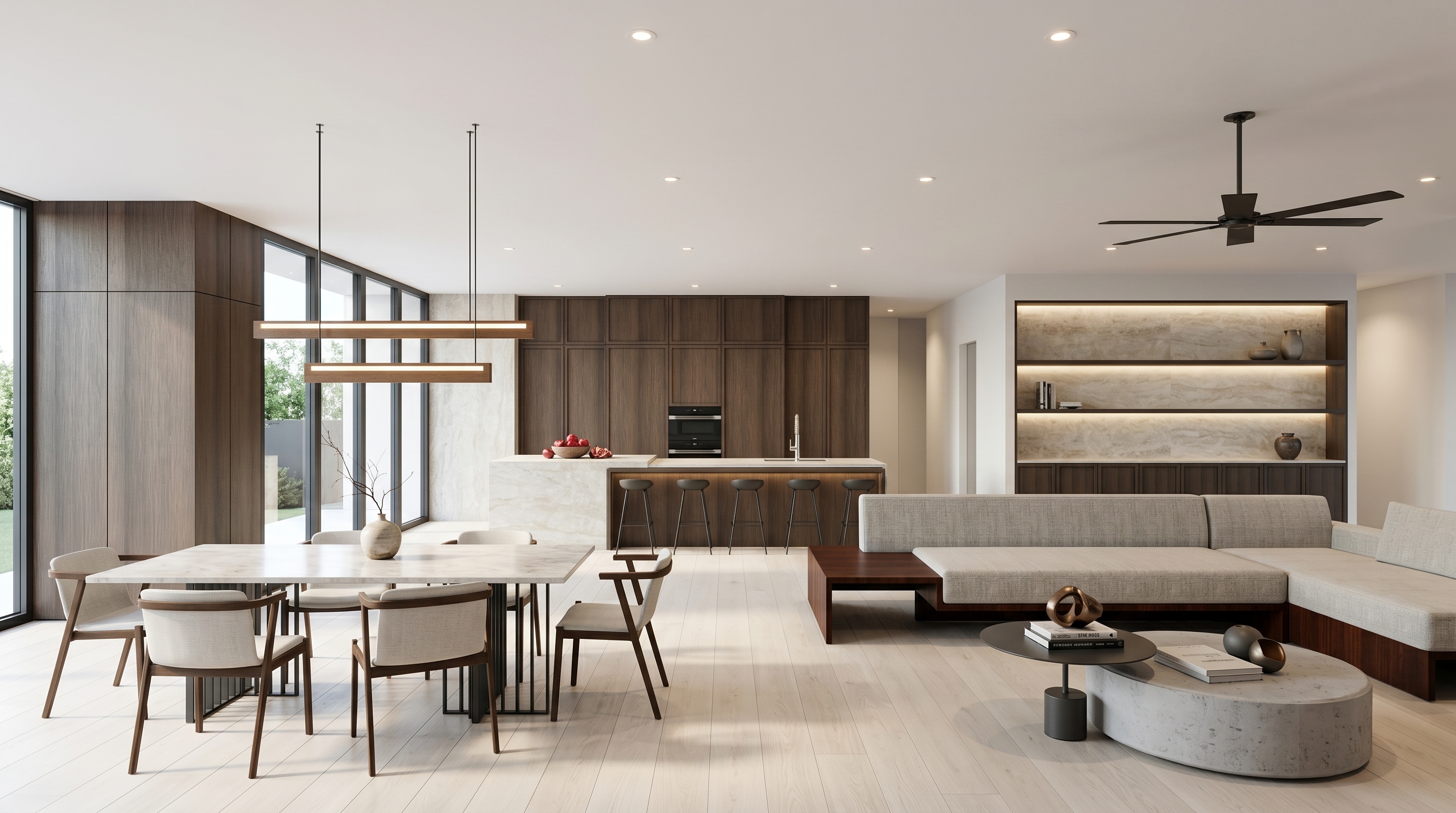
The other bill comes due in the plan. Cabinetry runs 24 inches deep. A standard-depth refrigerator, with doors and handles, pushes six inches or more past that line — and in an open kitchen, six inches of protrusion reads from across the room. It interrupts the one continuous horizontal the room has going for it.
It also eats circulation. The National Kitchen & Bath Association's planning guidelines call for at least 15 inches of landing area on the handle side of the refrigerator. On a protruding box, the swung door occupies part of that zone and part of the walkway behind it. The appliance you bought to make the kitchen more capable makes it slightly harder to move through, every day, forever.
Buy width and legibility, not depth
The practical move is to stop treating cubic feet as the specification and start treating reach as the specification. Cold that you can see and touch in one motion is worth more than cold you have to excavate.
- Go flush, then go wide. If you need capacity, buy it in width rather than depth — two 24-inch columns, or a refrigerator column paired with a separate freezer column, rather than one deep box.
- Put a little cold where you actually work. Refrigerated drawers under the prep counter hold the daily rotation — produce, dairy, the things a household touches every day — and keep the main cabinet closed.
- Respect the 15 inches. Landing area on the handle side is not a nicety. Without it, every trip to the refrigerator ends with a full-hand balancing act.
- Retire the garage refrigerator. It is the escape valve that lets the main one stay overstuffed. Remove it and the household self-corrects within a month.
- Specify full-extension shelving. If a shelf cannot come to you, its back third is decorative.
None of this is asceticism. It is the same logic behind every well-planned kitchen: storage is only storage if you can retrieve from it.
The counter-depth refrigerator was never the compromise. The compromise was the extra six inches — bought at a premium, filled with good intentions, and emptied into the bin. A kitchen is judged by what comes out of it, not by what it can hold.
Book a private showroom tour
If this changed how you are thinking about the refrigerator wall, the next step is not another article. Spend an hour with our design team and plan the cold storage around how your household actually cooks — column layouts, drawer placement, the run of cabinetry it all has to sit flush with.
Book a private showroom tour at a BauTeam studio — Atlanta, Boston, Burbank, Chicago, Dallas, Las Vegas, Los Angeles, or New York — for a one-on-one consultation.