
Craft
Heated Bathroom Floors Don't Warm the Room
Heated bathroom floors are sold as quiet luxury. They barely heat the room - what they actually correct is a material decision made months earlier.
Every luxury bathroom budget eventually arrives at the same line item. Heated bathroom floors read as the definition of restrained indulgence — invisible, expensive, pleasant in a way that cannot be photographed. Almost nobody asks what they actually do.
Here is what they do: they raise the temperature of one surface. In most rooms they do not heat the room. And the sensation they deliver — the entire reason anyone pays for them — is not a heating problem at all. It is a materials problem, created months earlier, when someone specified a dense polished stone for the one room in the house you enter barefoot and wet.
The mat is a correction. It is often worth buying. But it corrects a decision that could have been made better, and most of its money lands on the wrong question.
A Heated Bathroom Floor Is Not a Heating System
Electric floor systems are typically specified at 12 to 15 watts per square foot. A fifty-square-foot bathroom is therefore a 600 to 750 watt appliance — roughly a hair dryer, spread thin across a slab and asked to overcome the room's heat loss on a January morning. The industry's own guidance is honest enough about this: floor warming is treated as supplemental comfort heat, and is only called a primary heat source in a well-insulated room where measured heat loss falls below the system's output.
The U.S. Department of Energy is blunter still. Electric radiant floors are usually only cost-effective when they include significant thermal mass — a thick concrete slab that can be charged with cheap overnight electricity and coast for eight to ten hours afterward. A thin mat under porcelain on a wood-framed second floor has none of that. It has a thermostat and a schedule, and it shuts off with a lag you will feel.
None of which makes it a bad purchase. It makes it a mis-described one.
Cold Is a Property of the Material, Not the Room
What the sole of your foot registers is not temperature. It is the rate at which a surface pulls heat out of you. The property that governs this is thermal effusivity — the square root of conductivity times density times specific heat — and it is why a stone floor and a wood floor at identical temperatures produce entirely different verdicts. Stone and porcelain run roughly 1 to 3 W/(m·K) in thermal conductivity; wood sits near 0.1 to 0.2. An order of magnitude separates them, and your skin measures it instantly.
ASHRAE's thermal comfort standard puts an acceptable floor surface range at about 19 to 29 °C, or 66 to 84 °F. Read the fine print and the criterion assumes occupants in lightweight indoor shoes. The one room where the floor is the only thing touching you is the one room the comfort standard politely declines to describe.
The First Two Seconds Are the Only Ones That Count
There is a detail here that almost nobody in specification knows. The thermal instrument maker Thermtest measured three floor tiles of varying surface roughness at two contact times: two seconds and ten. At ten seconds — long enough for heat to reach the bulk of the material — the three tiles spread across roughly 400 effusance units. At two seconds, that spread collapsed to about 100.
At the moment your foot actually lands, in other words, surface texture matters more than what the tile is made of. Roughness traps air at the point of contact, and air is a spectacularly poor conductor. A honed tile and a polished one can be the same stone and not the same floor.
That is the whole game in a bathroom. Nobody stands on a tile for ten seconds evaluating it. You step out of a shower, reach a verdict in under two, and carry that verdict for the life of the room.
Specify the First Two Seconds, Then Heat the Room
If you are going to spend on radiant floor heating, spend it where it does work, and solve the rest with material selection rather than watts.
- Put the sensor in the floor, not on the wall. An air-sensing thermostat regulates the room. A floor sensor regulates the surface, which is the only thing you actually bought.
- Insulate underneath. Without an insulation board or uncoupling layer beneath the element, a meaningful share of the output heats the subfloor on its way down to the joists.
- Heat where you stand, not where the plan is empty. The vanity approach and the shower exit. Not beneath a tub, not under a cabinet run.
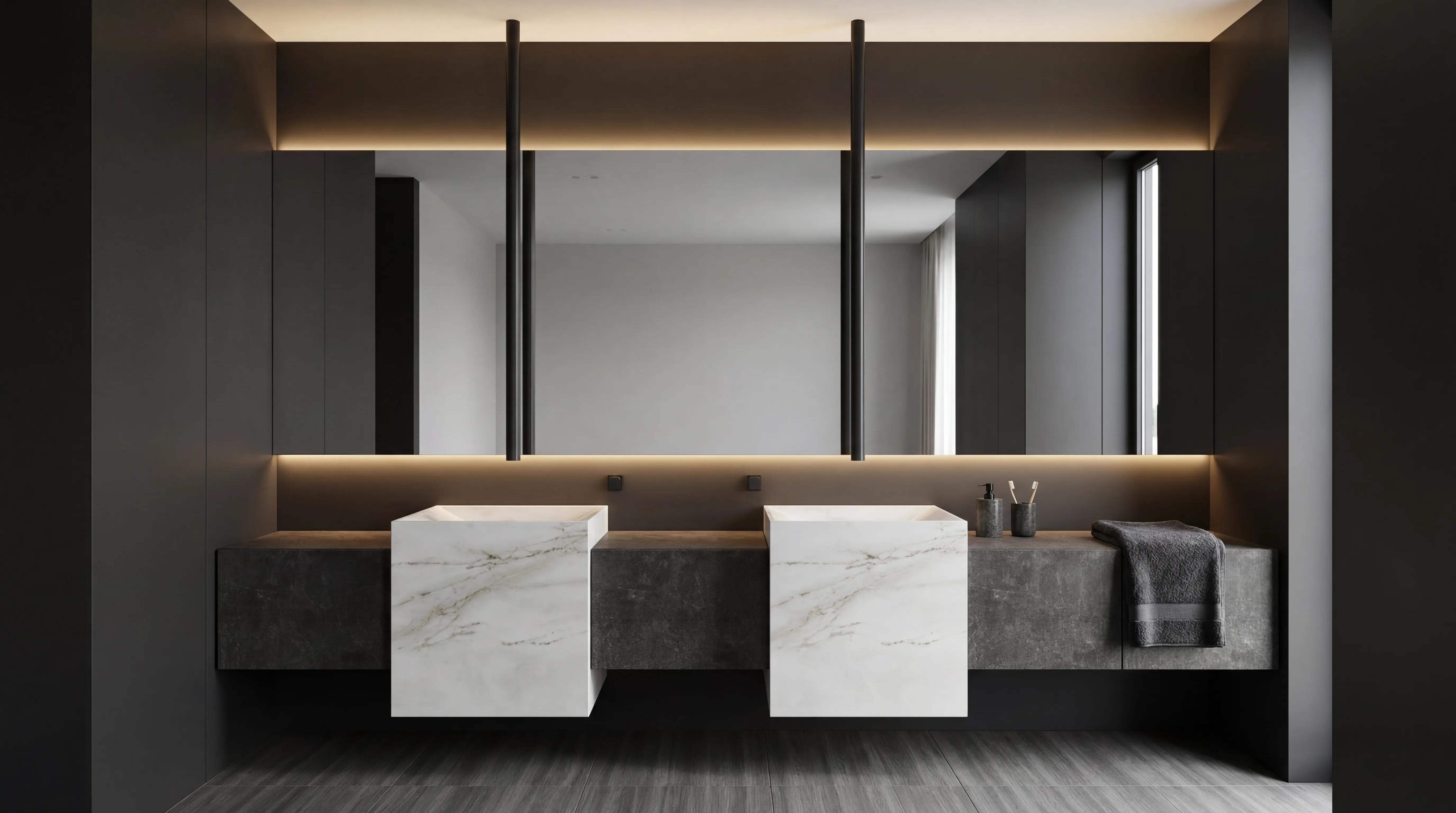
- Choose the finish by touch. Honed, textured, or lightly riven at every barefoot zone. Polished slab belongs on a wall or a vanity top, where skin rarely meets it cold.
- Give the room warm contact points. A veneered timber shower bench, a warm-toned toe recess, a wood-fronted vanity rather than a lacquered plinth that meets your shin at six in the morning.
- Handle the air separately. Floor heat cannot outrun a room that is being over-ventilated or under-dried — that is a ventilation question, not a heating one.
A heated floor is a fine thing to own. It is a poor thing to rely on. The bathrooms that feel warm were designed around the surfaces a body touches, and then, quietly, wired for a few hundred watts underneath.
Book a Private Showroom Tour
If this changed how you are thinking about the surfaces in your bathroom, the next step is not another article. Book a private showroom tour and spend an hour with the BauTeam design team — in Chicago, New York, Dallas, Atlanta, Boston, Los Angeles, Burbank, or Las Vegas — with the materials in your hands, at room temperature, where the decision actually gets made.