
Craft
Your Walk-In Closet Island Is Working Against You
The walk-in closet island is the status symbol of the luxury closet. In most rooms it steals the clearance you need — and gives shallow storage back.
The walk-in closet island has become the shorthand for a serious closet. A low run of drawers, a stone top, a velvet tray staged with a watch and a folded pocket square. It photographs beautifully, which is most of why it exists. It is also, in the majority of rooms it lands in, the single element working hardest against the closet it was meant to crown.
The conventional wisdom is that an island is the moment a closet graduates into a dressing room. The truer version is narrower. An island earns its keep in a genuinely large room and quietly undermines every room below that threshold — which is to say, most of them.
The island is not a storage decision. It is a photograph you have to walk around every morning for the next twenty years.
The island needs a room most closets don't have
Freestanding storage in the center of a room only works if you can move freely on every side of it. The figure designers keep landing on is three feet — roughly 36 inches — of clearance on all four sides of the island. That is not a comfort target; it is the point below which you start turning sideways to pass. It lines up with the NKBA's planning guidelines, which set a minimum walkway of 36 inches for exactly this reason.
Run the arithmetic and the island reveals its appetite. A modest island of two feet by four, ringed by three feet of clearance, wants a clear floor of roughly eight by ten feet before a single garment goes on the walls. That is why the honest guidance is not to attempt an island under about ten by ten feet, or a hundred square feet of room. Below that, the island doesn't sit in the space — it colonizes it, and pushes you back against your own hanging rods.
Shallow drawers, dressed up
Set the footprint aside and the island still underdelivers on the one thing it is sold to do: store. Closet-island drawers typically run 14 to 16 inches deep, and on a double-sided island they get shallower still, because two banks of drawers have to share the width. A freestanding bedroom dresser, by comparison, gives you 16 to 20 inches. You are building a permanent, stone-topped piece of millwork that holds less per drawer than the dresser it replaced.
What the island is good at is display and single-layer items — jewelry, watches, folded knits seen from above. Those are real uses. They are also a small fraction of what a wardrobe actually contains, and a poor trade for the floor they consume.
The perimeter is where the storage actually lives
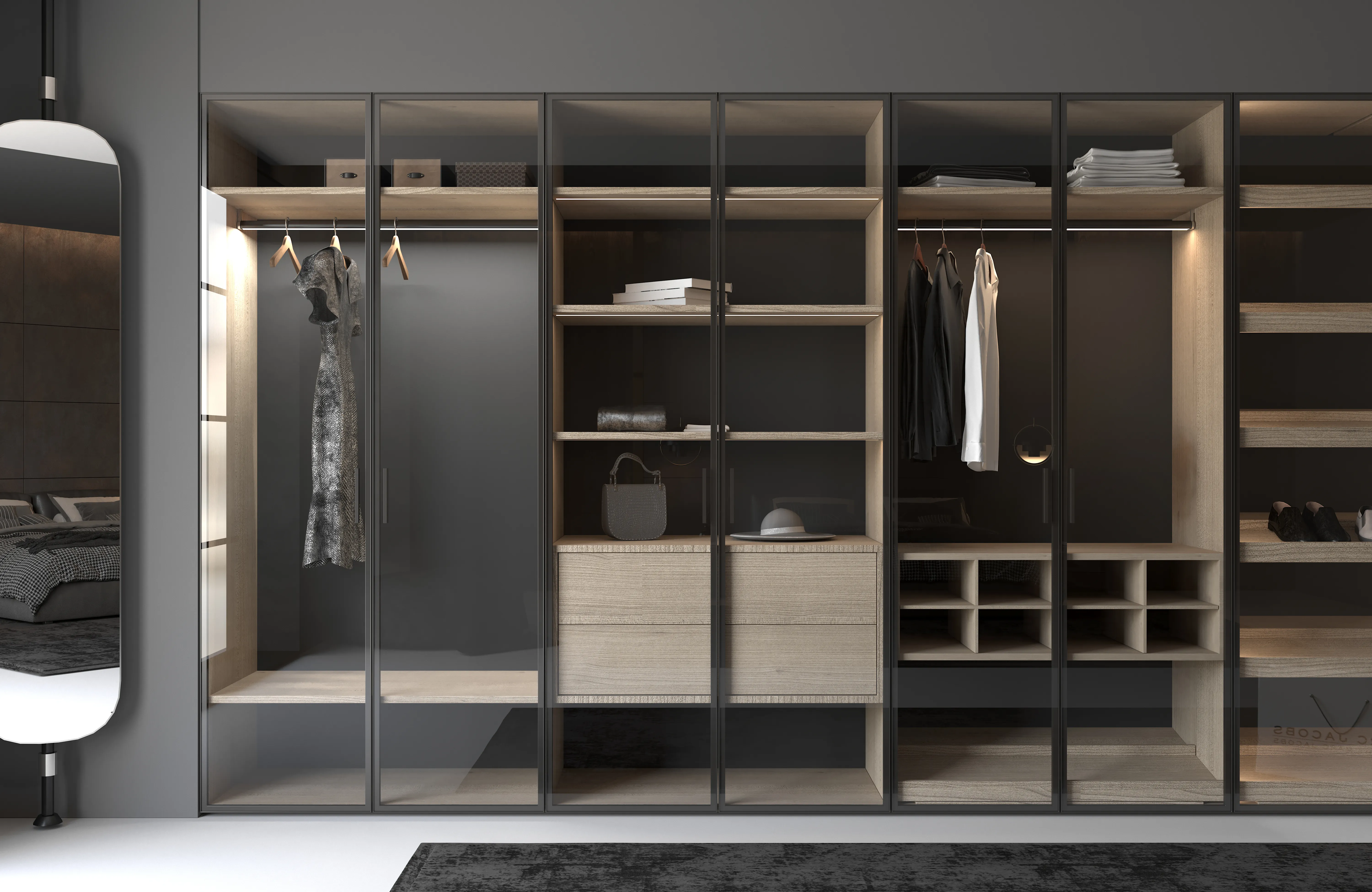
The walls are the part of a closet doing the quiet, unglamorous work. Stack a pair of rods — the standard heights are 40 and 80 inches from the floor — and a single run of wall stores roughly twice the hanging length of a single rod. Add full-depth shelving above and drawers below, and the perimeter of even a modest room outperforms any island you could stand in the middle of it.
An island competes with that perimeter for the same finite square footage. In a large room, there is enough to go around. In an average one, every inch the island claims is an inch the walls could have used better.
What to do instead of an island
Give the walls everything first. Design the full perimeter — double-hang where you can, full-depth drawers, shelving to the ceiling — before you decide whether anything belongs in the center at all. In most rooms the answer is a slim bench or a narrow, low console, not a full island: somewhere to sit and to set a tray, taking a fraction of the floor and none of the storage.
Reserve the island for the room that can genuinely spare it — a clear ten by ten at minimum, with a true three feet open on every side. When the room passes that test, an island is a pleasure. When it doesn't, the discipline to leave the floor empty is what separates a dressing room that works from a showroom you can't quite move through.
The best closets we build are not the ones with the most in the middle. They are the ones where the center is calm because the walls are doing their job. An island is a reward for a large room — not a way to make a small one feel large.
Book a private showroom tour
If this changed how you're thinking about your closet, the next step isn't another article. Book a private showroom tour and spend an unhurried hour with our design team, one on one — at our Atlanta studio in Buckhead or any of our showrooms across the country. We'll plan the room around how you actually dress, before a single drawer is drawn.