
Craft
The Pot Filler Solves Only Half the Problem
The pot filler is the status faucet of the serious kitchen. It fills a pot but never drains one — and it puts a water line exactly where you least want it.
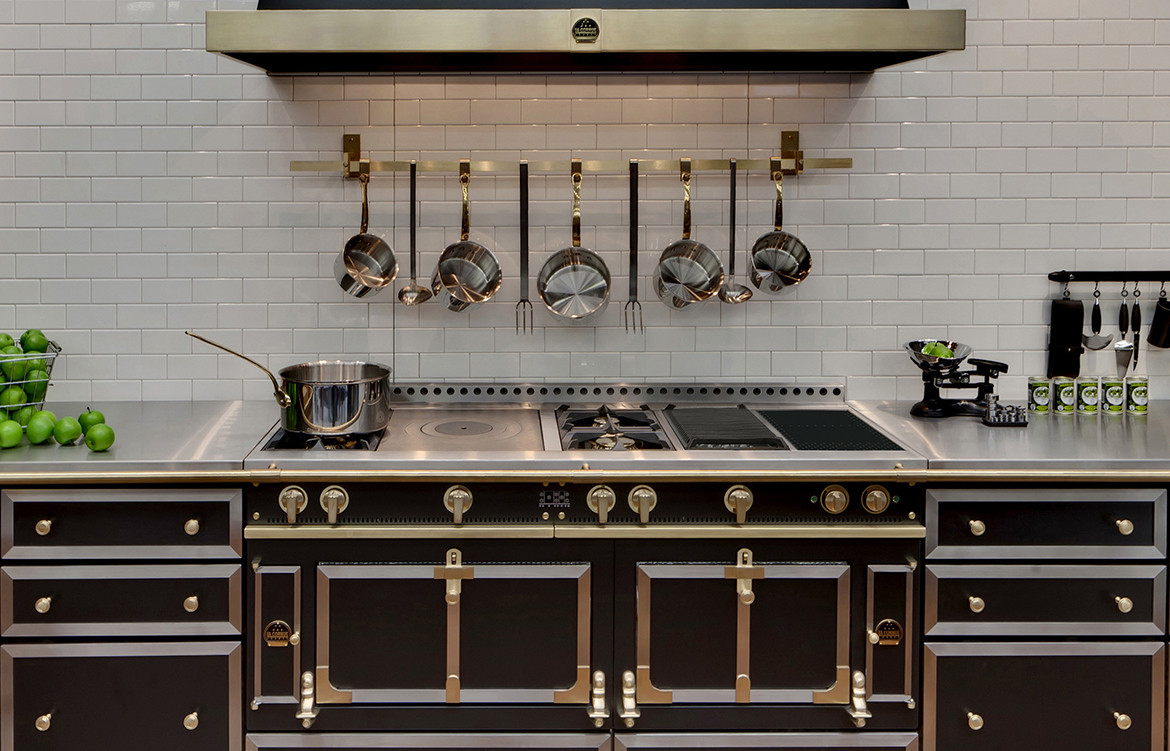
The pot filler arrived in the luxury kitchen as a kind of credential. A folding brass arm over the range, ready to swing out and fill a stockpot where it sits — the mark of a kitchen that means business. It photographs beautifully. It signals a cook who is serious enough to need one.
It is also the rare fixture that solves exactly half of the problem it claims to.
A pot filler fills. It does not drain. Water is heavy — a gallon runs about eight pounds — so the appeal is real: no hauling a full pot from sink to stove. But the pot does not empty itself on the range. Once the pasta is done, you still lift a scalding, brimming pot and carry it back to the sink you were trying to avoid. The hard trip was always the return.
The fixture only removes the easy half of the trip
Think about the two journeys a stockpot actually makes. Empty pot to the stove, and full pot to the drain. The first is light and safe. The second is heavy and hot. The pot filler eliminates the first and leaves you the second — the one where a cramping wrist or a wet floor actually matters. It is a solution aimed at the wrong direction of travel.
There is no drain over a cooktop, and there never will be. So the convenience a pot filler offers is capped at the moment the burner comes on.
You are putting a water line where you least want one
Every plumbed joint is a future leak. That is tolerable under a sink, where a drain sits directly below and a cabinet floor catches what escapes. It is a different proposition on the wall behind your range, directly above a gas or induction cooktop, with nothing beneath the fitting but heat, electronics, and your finish materials.
The trade press is blunt about this. A leaking pot filler can ruin the range, the wall, and the floor; one widely cited failure ran to roughly $20,000 in water damage. Installers warn of a subtler hazard too — over-tightening the connection during install can crack an expensive slab or tile backsplash before the faucet has poured a drop. You are accepting a standing risk in the worst possible location to buy back one of a pot's two trips.
The pot filler math rarely favors the arm
The faucet is the cheap part. A pot filler runs roughly $150 to $1,000 on its own. The plumbing is where it lands: installation with an accessible existing line can reach about $1,650, and running a new water line to a wall that never had one climbs toward $3,000. That is real money spent to move a water source a few feet — and then a fixture that lives in the greasiest zone of the kitchen, its folding joints and arm collecting the film that every cooktop throws off.
None of this makes the pot filler indefensible. In a genuine working kitchen — a long run where the range sits far from the sink, or a household with two cooks crossing paths — it earns its keep. The mistake is treating it as a default. Most kitchens install one because the reference photos had one, not because the layout asked for it.
What to do instead
Start with the layout, not the fixture. If your sink and range already sit within a step or two of each other — the case in most well-planned kitchens — the pot filler is solving a problem you do not have. Put the money into the trip that is actually hard: a deep, low prep sink close to the cooktop, or a second small sink in the island, so the full pot has somewhere near to go. If you cook at volume with the range genuinely stranded across the room, specify the pot filler on purpose, with a quality valve and a plan for the joint. Buy it for your kitchen, not for the photograph.
The test for any fixture is simple: does it remove work, or does it remove the appearance of work? The pot filler is fluent in the second. Fill the pot at the sink, walk the four steps, and put the twenty thousand dollars somewhere it can't fall on your stove.
See it before you plumb it
If this changed how you are thinking about your range wall, the next step isn't another article. Book a private showroom tour and spend an hour with our design team, one on one — in Buckhead, SoHo, or any of our studios across the country — working through the fixtures that earn their place in a kitchen engineered around how you actually cook.